
Creatine powder vs. capsules: what’s worth paying for?
Same ingredient. Different routines—and a surprisingly different cost per gram. Here’s how to choose without paying for claims the evidence cannot support.
Start with powder if value comes first.
Plain creatine monohydrate powder is our practical starting point for a budget-conscious buyer. Capsules can make sense if avoiding loose powder matters more to you than cost or pill count. Neither format earns a performance advantage simply from its packaging.
See the real price comparison ↓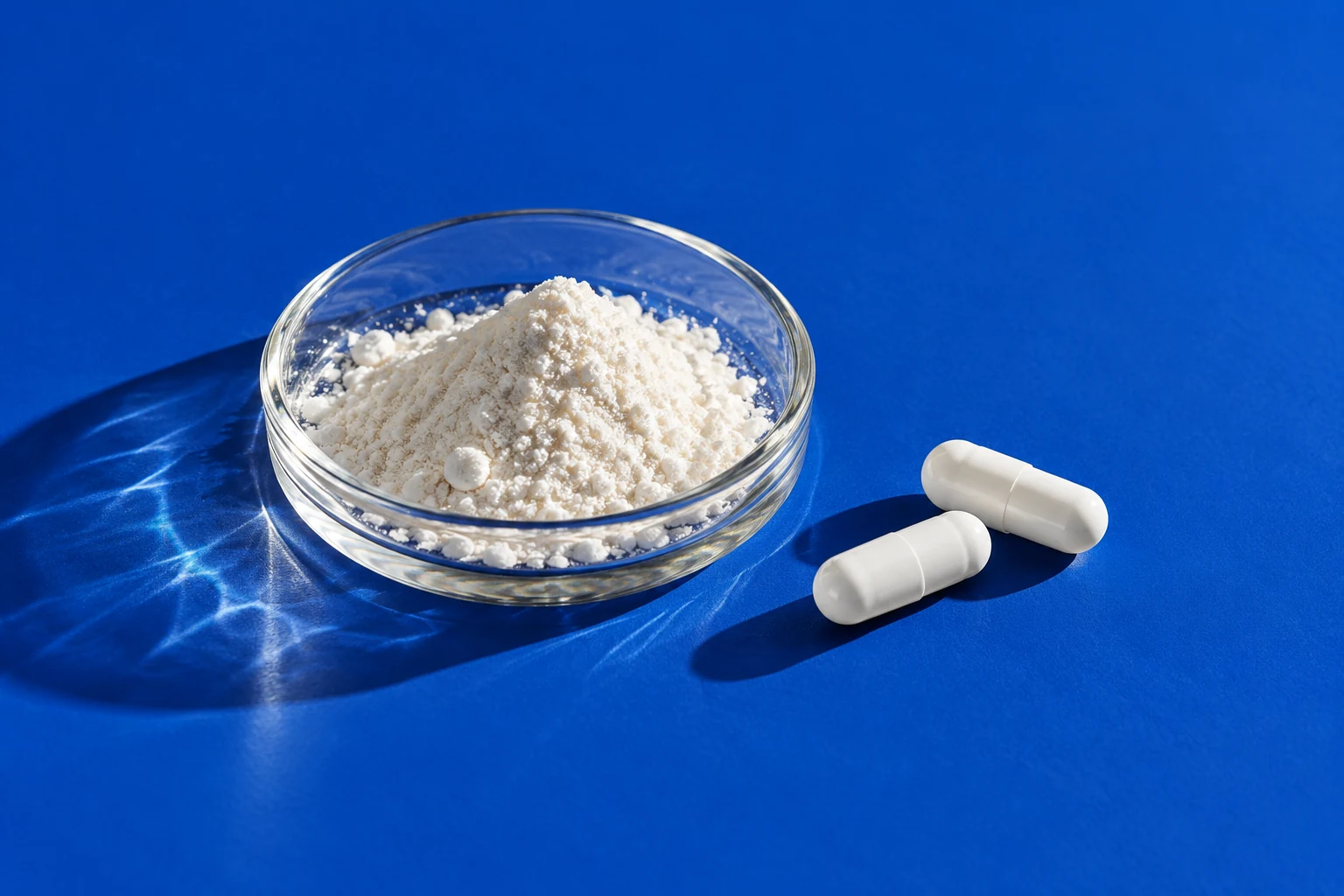
What does creatine actually help with?
Creatine helps supply energy during short, intense efforts. Its strongest practical case is alongside repeated high-intensity exercise and resistance training; it is not a general endurance booster. Monohydrate is the form with the most research behind it. [1]
23 studies. A useful signal, with limits.
A 2024 meta-analysis of resistance training in adults under 50 included 509 participants. Creatine groups gained more strength overall than placebo groups. But 20 of the 23 studies included only men, which limits how confidently the results represent everyone. [2]
What this means: there is a research-based reason to consider the ingredient. This analysis does not establish that a particular capsule or powder brand works better, and it cannot predict your personal results.
“Monohydrate” describes the ingredient; “powder” and “capsule” describe the format. We do not have direct head-to-head clinical evidence in the sources reviewed here that establishes a performance winner between these two products. Our recommendation below is about cost and convenience.
Compare the amount, not the bottle price
A capsule bottle can look cheaper while containing much less creatine. We selected two plain monohydrate products from one manufacturer to make that trade-off easy to see. This is a worked buying comparison, not a ranking of the whole market.
| Product | Pack / label amount | Price | Cost per 3 g* |
|---|---|---|---|
| NOW micronized powder | 500 g 4.2 g per label serving | $22.49 sale $29.99 regular | $0.13 $0.18 regular |
| NOW 750 mg capsules | 120 capsules / 90 g total 4.5 g per 6-capsule serving | $18.99 | $0.63 |
*3 g of declared creatine monohydrate is a common comparison unit, not a personalized dose or either product’s label serving. Prices exclude shipping and tax; promotions and availability change. Sources: powder label and price, capsule label and price.
What the same 3 g costs
Show the calculation
Powder: $22.49 ÷ 500 g × 3 g = $0.13494. At regular price: $29.99 ÷ 500 × 3 = $0.17994. Capsules: 120 × 0.75 g = 90 g; $18.99 ÷ 90 × 3 = $0.633. Divide the unrounded costs to compare prices. All amounts refer to creatine monohydrate, not the weight of capsule shells.
Include delivery costs before deciding. A sale at one store does not prove powder is always cheaper everywhere. A bigger tub also requires more money upfront; buying more than you will use is not automatically good value.
How many capsules does that mean?
One equal amount, two ways to measure it
Use grams; scoop and teaspoon sizes vary.
4 × 0.75 g = 3 g monohydrate.
A front label that says “750 mg” may describe one capsule, while the Supplement Facts panel describes several. Likewise, a flavored powder’s total scoop weight may include ingredients besides creatine. Check the actual declared creatine amount before comparing anything.
Which format fits your routine?
Consider powder
A useful fit if you can measure it and prefer a lower cost per gram. The trade-off is carrying and handling loose powder.
Consider capsules
A useful fit if premeasured units suit your routine and swallowing several capsules is comfortable. Check the pill count before buying.
We have not tested taste, texture, capsule size, or mixing. “Micronized” does not earn a better-results rating here. Check other ingredients too: the compared powder lists none; the capsules include a cellulose shell and vegetable-source stearic acid. Powder details · Capsule details.
Ready to compare the actual labels?
Open the manufacturer’s page, select the exact pack size, and check the delivered price before buying.
These are direct manufacturer links. We currently earn no commission from them.
Do you need a loading phase?
Loading is a way to raise muscle creatine stores faster, not a requirement to buy more. In a small 1996 study of 31 men across several protocols, 3 g daily increased muscle creatine more gradually over 28 days; a higher loading protocol raised it over six days. This measured muscle stores, not a guaranteed change in strength, and the participants were all men. [3]
The NIH describes research protocols commonly using 3–5 g daily after loading. That research context is not a personalized instruction: suitability and product directions still matter. [1]
What should you check before taking it?
Creatine can cause water-related weight gain and gastrointestinal discomfort. An early rise on the scale should not be read as new muscle. [1] A 2026 kidney-function meta-analysis covering 20 randomized studies found increased serum creatinine without statistically significant changes in estimated filtration rate or urea. The authors still called for more trials lasting beyond one year. This does not establish safety for every person or health condition. [4]
If you have kidney disease, are pregnant or breastfeeding, take medication, or have another medical condition, ask your clinician before use; the compared products are labeled for adults. Tell your clinician about creatine use when discussing blood tests. Manufacturer cautions · Kidney evidence.
Quality is a separate question from price. If sport certification matters to you, verify the exact product in the certifier’s directory. NSF’s Certified for Sport program includes screening for banned substances; it does not establish that a supplement will improve your results. We have not verified either compared product in that directory. [5]
Our recommendation
For someone who has decided creatine is appropriate and prioritizes cost, start by comparing plain monohydrate powders. Choose capsules when the practical benefit is worth their cost and pill count to you. Keep your choice tied to an actual label, an actual delivered price, and a routine you can sustain.
Sources & how we researched this
We reviewed NIH guidance, human research summaries, and the manufacturer’s current US product pages. This is an editorial synthesis, not a systematic review or medical assessment. Studies below concern the ingredient; product pages supply label and price data only. Sources checked October 7, 2026.
- NIH Office of Dietary Supplements: Exercise and Athletic Performance. Evidence overview, use patterns and adverse effects.
- Effects of Creatine Supplementation and Resistance Training on Muscle Strength Gains in Adults <50 Years (2024). Systematic review and meta-analysis; 23 studies.
- Hultman et al. Muscle creatine loading in men (1996). Human clinical study; 31 men.
- The Effect of Creatine Supplementation on Kidney Function (2026). Systematic review and meta-analysis of randomized trials.
- NSF: Certified for Sport program and product directory.
- NOW micronized monohydrate powder. 500 g product; Supplement Facts and price.
- NOW monohydrate 750 mg capsules. 120-capsule product; Supplement Facts and price.